
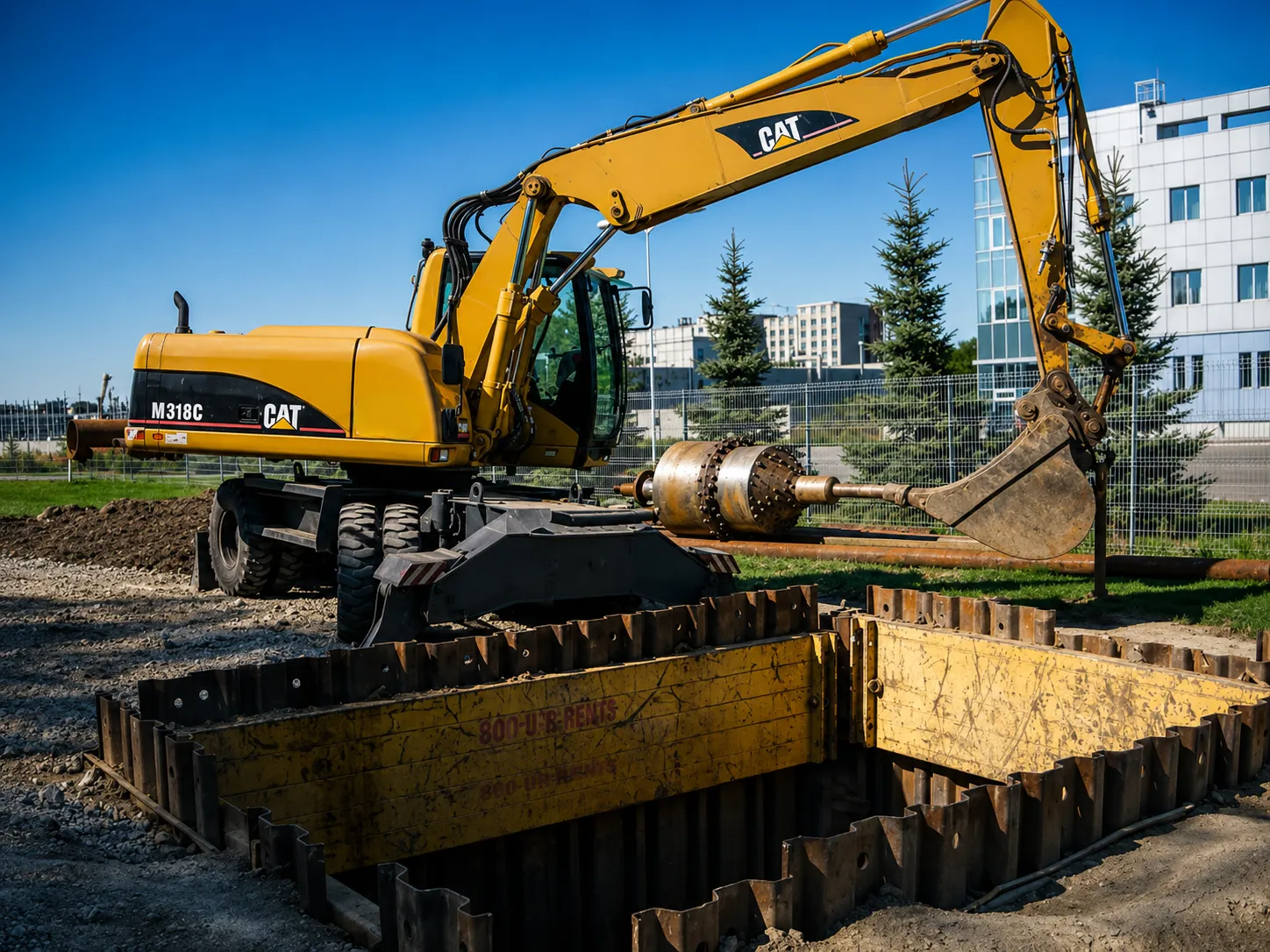
Pipe bursting
A bursting head with a conical expander statically destroys the old pipe, pushes the fragments into the surrounding soil and simultaneously pulls in a new PE pipe along the existing route — without opening the whole section.
How the work is carried out
A simplified scheme of the key stages. Scroll to see the sequence.
Typical applications
- Full replacement of failing water and sewer lines along the old route
- Keeping or increasing the diameter during replacement
- Networks under roads and buildings where open replacement is impossible
- Water supply and sewerage, including pressure networks
Things to consider
- Access to manholes/pits at both ends of the section is required
- The old pipe’s condition and material define forces and tooling — diagnostics needed
- Nearby utilities along the route are verified by tracing
Technical capabilities
Work stages
- 01
Survey
Site visit, initial data collection; tracing and video diagnostics if needed.
- 02
Estimate & quote
Engineering calculation, technology and material selection, commercial proposal.
- 03
Preparation
Method statement, equipment mobilization, pit and site setup.
- 04
Execution
Work under the approved design with quality control at every stage.
- 05
Testing & handover
Pressure testing, video check, as-built documentation, acceptance act.
What the customer gets
- Acceptance act and as-built documentation
- Testing / pressure test results
- Warranty obligations
FAQ
When is pipe bursting better than relining?
If the old pipe is destroyed or a larger diameter is needed — pipe bursting. If the pipe retains its bearing capacity — relining is enough. The decision follows video inspection.
Can the diameter be increased with pipe bursting?
Yes, the method allows pulling in a larger pipe while bursting the old one.
How much excavation is needed?
Only launch and reception pits (or existing manholes) — the route between them stays closed.