
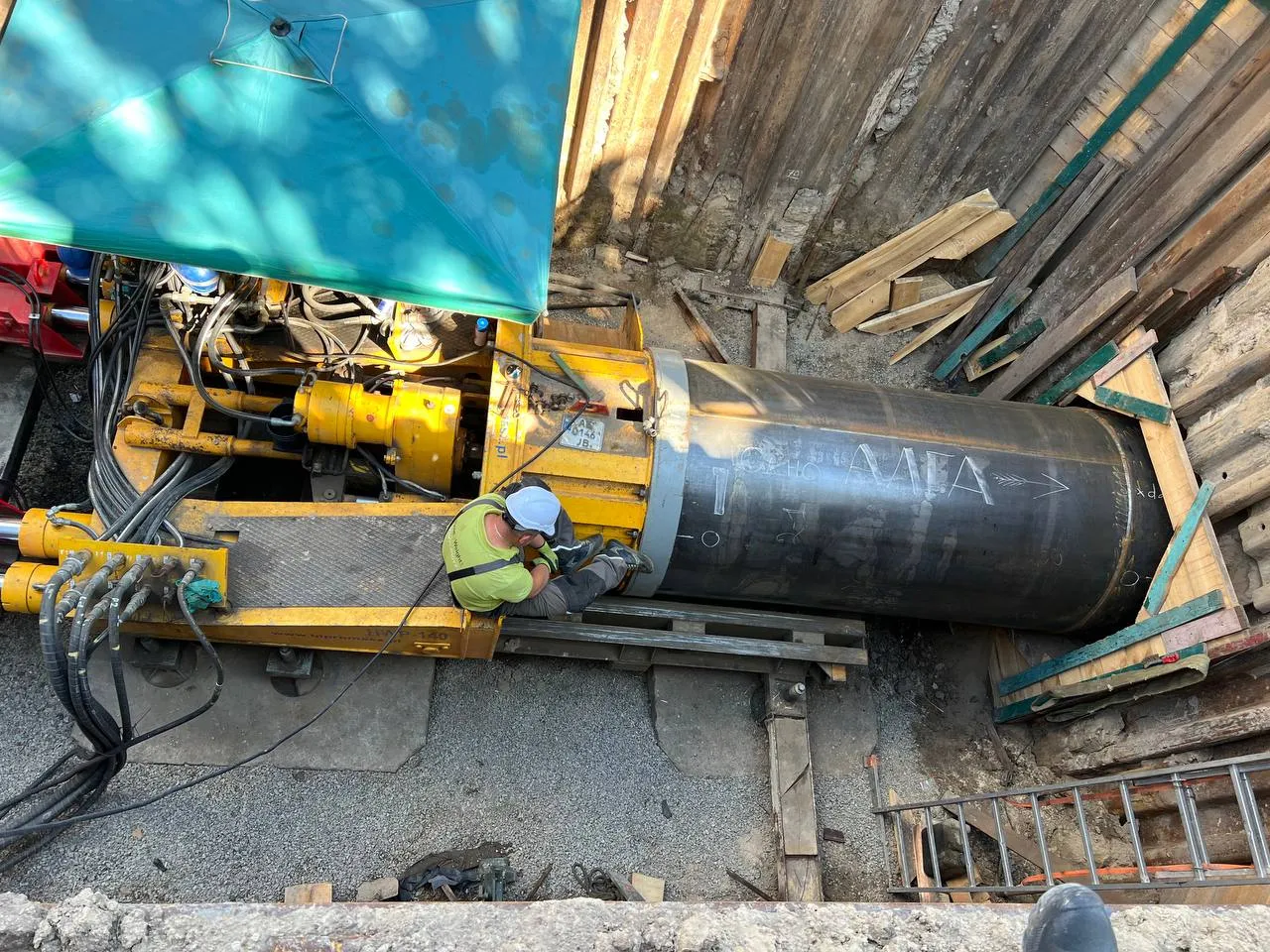
Guided piercing
Guided trenchless installation of pipelines and protective casings up to DN 350 beneath roads, pavements and developed areas.
How the work is carried out
A simplified scheme of the key stages. Scroll to see the sequence.
Typical applications
- Small- and medium-diameter water and gas networks
- Pressure sewer lines
- Cable ducts and communication lines
- Protective casings beneath roads, pavements and yards
- Short local crossings in confined sites
- Projects with insufficient room for a large surface HDD rig
Things to consider
- The service range is up to DN 350
- A launch and reception pit, or suitable work chambers, are required
- The method is best suited to soils without large boulders or hard rock
- Length and steering capability depend on the rig, rods, diameter and geology
- Feasibility is confirmed after utility tracing and a site survey
Technical capabilities
Work stages
- 01
Route survey
Obstacle identification, utilities, depth, length and required diameter.
- 02
Method selection
Rig, rods, steerable head, reamer and pipeline calculation.
- 03
Pit preparation
Safe work area setup and rig installation.
- 04
Piercing and pullback
Pilot pass, bore reaming and pipe pullback.
- 05
Testing and handover
Route verification, network testing and documentation.
What the customer gets
- Acceptance act and as-built documentation
- Testing / pressure test results
- Warranty obligations
FAQ
How does guided piercing differ from HDD?
Guided piercing uses a compact rig operating from the launch pit. The bore is formed mainly by displacing and compacting the soil, rather than full-scale drilling with a large surface HDD spread.
What is the maximum pipe diameter?
The stated range covers pipes and casings up to DN 350. The final diameter depends on soil conditions, crossing length and pipe material.
Does the road need to be closed?
Not normally. Work is carried out under the surface from launch and reception pits located outside the main crossing zone.
In which soils is the method not recommended?
Hard rock, large boulders, construction debris and highly variable soils can present difficulties. Feasibility is determined after a site survey.