
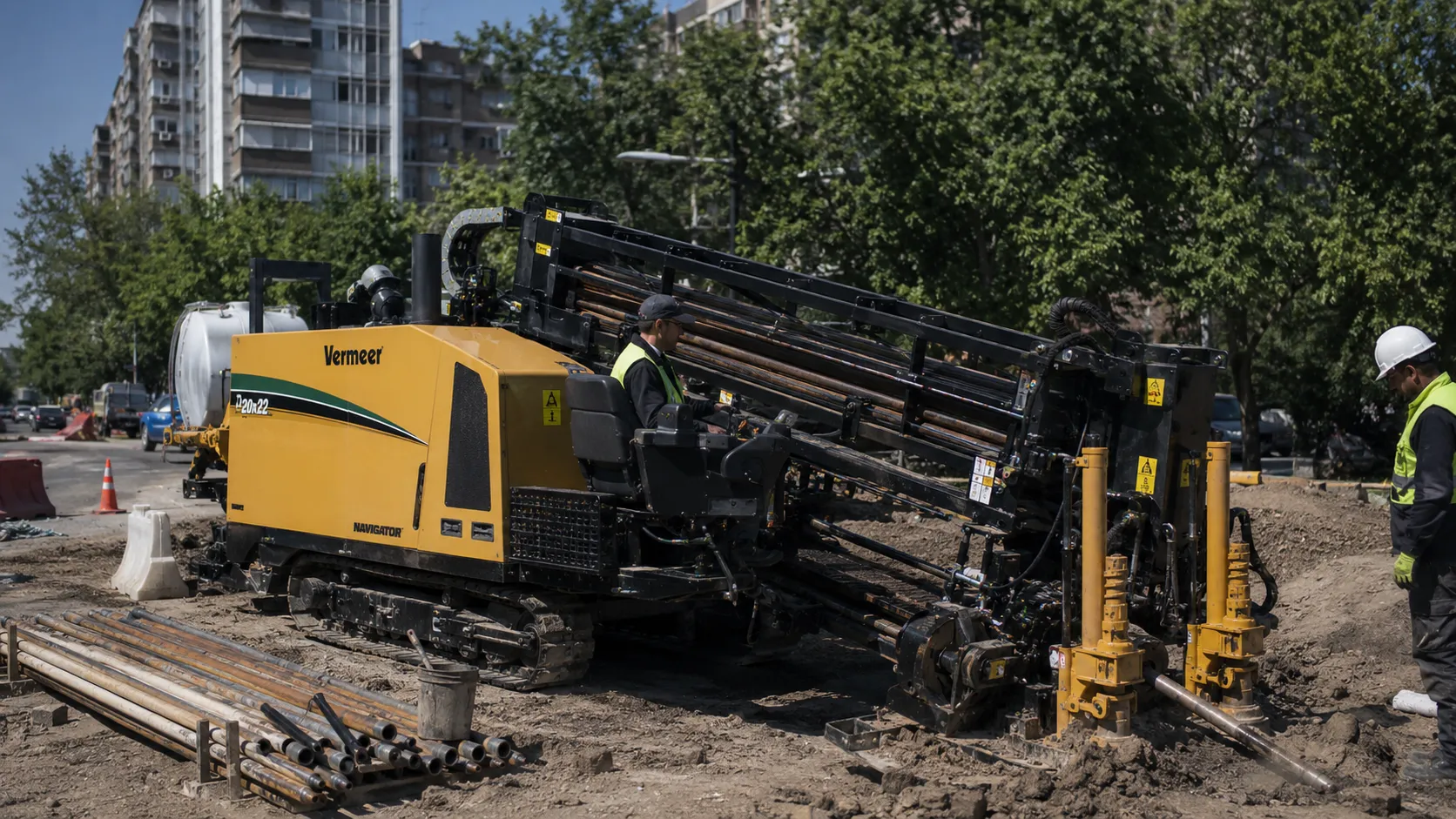
Horizontal directional drilling (HDD)
Trenchless pipeline installation under roads, rivers, railways and buildings — without opening the surface or stopping traffic.
How the work is carried out
A simplified scheme of the key stages. Scroll to see the sequence.
Typical applications
- Crossings under highways and railways
- Laying networks under rivers, ravines and other obstacles
- Work in dense urban development without damaging landscaping
- New construction of water, sewer and gas lines, cable casings
Things to consider
- Geology data is required: rocky soils and quicksand need a tailored approach
- Entry and exit points with sufficient space for the rig are necessary
- The exact price is set after a survey: diameter, length, depth, soils
Technical capabilities
Work stages
- 01
Survey
Site visit, initial data collection; tracing and video diagnostics if needed.
- 02
Estimate & quote
Engineering calculation, technology and material selection, commercial proposal.
- 03
Preparation
Method statement, equipment mobilization, pit and site setup.
- 04
Execution
Work under the approved design with quality control at every stage.
- 05
Testing & handover
Pressure testing, video check, as-built documentation, acceptance act.
What the customer gets
- Acceptance act and as-built documentation
- Testing / pressure test results
- Warranty obligations
FAQ
What data is needed for an HDD estimate?
Pipe diameter and material, crossing length, depth, soil type (geology report if available), entry/exit points and nearby utilities.
Does the road need to be closed during drilling?
No. Drilling is performed under the road without opening the pavement; traffic is not stopped.
How long does a crossing take?
It depends on diameter, length and soils. A typical DN 110–315 crossing up to 100 m takes a few working days including preparation.
What about existing underground utilities?
Before drilling we trace existing networks and align the bore path to rule out damage.